Contents
- Endoscopic Deep Plane Facelift: What It Is, Who It Suits
- Endoscopic Facelift Cost: Comparing Azerbaijan, the US, and Europe
- Endoscopic Brow Lift: Complete Guide
- Why Natural-Looking Facelifts Are Becoming the New Standard in 2026
- Endoscopic Deep Plane Facelift & Advanced Facial Rejuvenation
- Modern Plastic Surgery
- Forehead Lift: Youthful Look with Minimal Scarring
- Waist Slimming Surgery Without Rib Removal In Baku
- Scars After a Deep Plane Facelift, Why They Heal So Well
Breast augmentation surgery
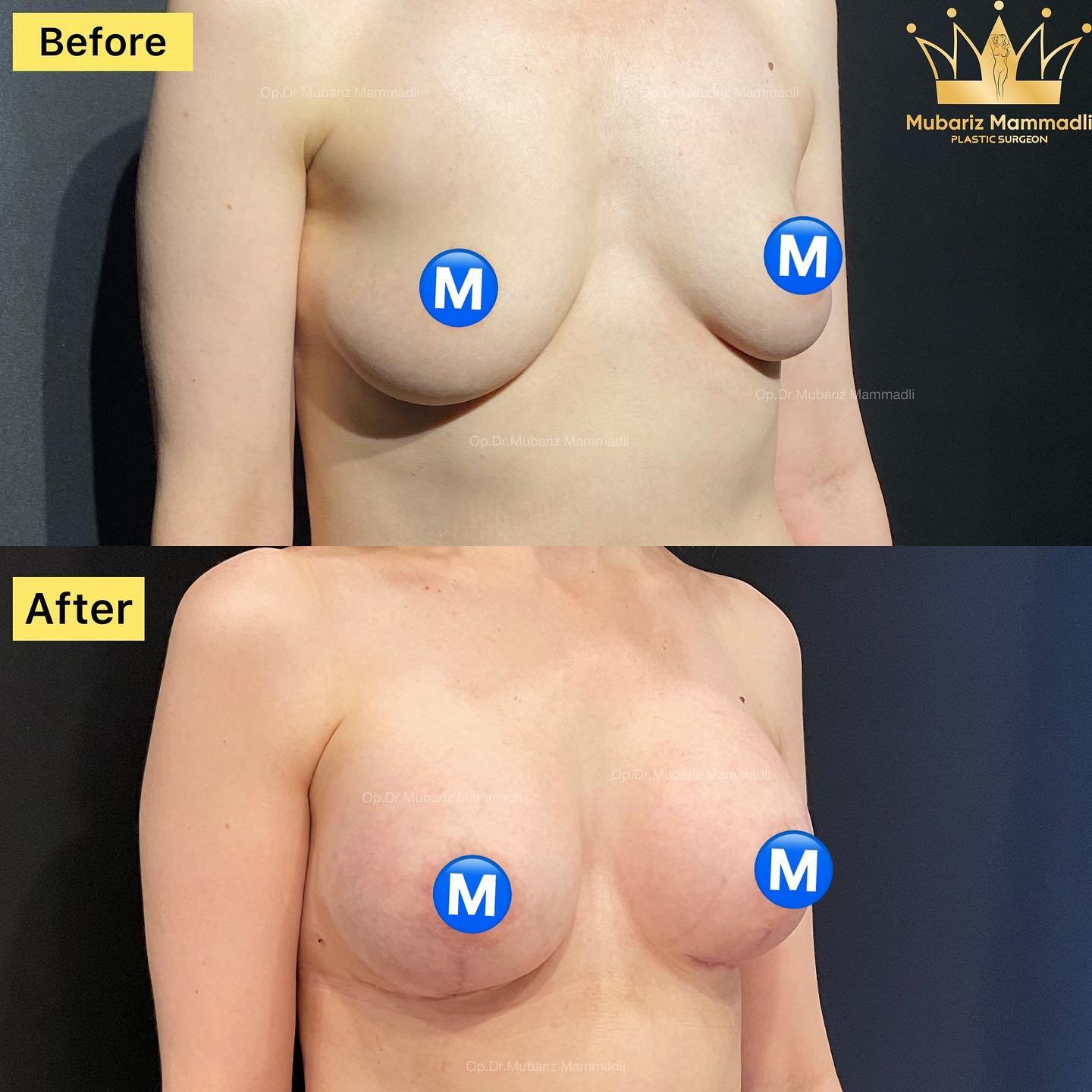
Breast augmentation surgery is one of the most popular operations in plastic surgery for women. Many patients visit plastic surgery clinics asking for breast enlargement.
One of the most common concerns is the loss of shape and volume after pregnancy and breastfeeding. A breast lift solves that issue. Plastic surgery on the breast lets you reach your desired aesthetic result. It also gives a woman comfort and a distinctive sense of attractiveness.
Breast augmentation surgery: techniques
Breast augmentation surgery cost
The cost of breast augmentation surgery depends on the technique used and on the patient's specific needs. So let's first review the surgical techniques.
Submammar breast augmentation
In this technique, a 4-5 cm incision is placed in the fold beneath the breast. During the operation, the plastic surgeon can watch the procedure visually. For that reason, it is traditionally considered the safer option. It is also the most popular method among patients.
Over time, the breast that has been enlarged this way settles a little. It takes on a more natural shape and hides the incision under the breast fold. The scar fades over time into a thin white line.
Note that this technique can be tricky for very slim women with micromastia (very small breasts). The scar will be quite visible in that case. This method is the traditional choice for augmentation mammoplasty.
Periareolar breast augmentation
In the periareolar approach, the incision sits around the areola, or as a crescent at the lower edge of the areola. This method is usually not recommended for women who plan a future pregnancy and breastfeeding. The periareolar approach disrupts the breast tissue.
The surgeon tries to handle the gland gently with blunt dissection. The advantage of this method is that the surgical marks are practically invisible. They sit along the edge of the areola. Once the scar matures, areola tattooing can be performed.
In breast surgery practice, the periareolar approach is the most commonly used. The transaxillary method is a more interesting alternative. It is a very different approach, because endoscopic equipment is used to visualise the blood vessels and to create the pocket.
It is a technically elegant operation. It is also an advantage for the patient. The scar stays hidden in the armpit. The silicone is placed under the muscle, with no contact with the breast tissue. It does not extend to the edges.
Endoscopic breast augmentation
The endoscopic breast augmentation technique is considered more complex and high-tech. The operation is performed with costly endoscopic equipment. Vessels and nerves are visualised during implant placement.
Their integrity can be preserved. A 3-4 cm incision is made in the armpit. The scar remains practically invisible. It fades over time and hides within the natural folds of the axilla.
This method is traditionally recommended for women who plan a future pregnancy and breastfeeding. The breast tissue remains untouched. The implant sits under the pectoralis major and does not touch the gland.
The drawbacks are the long path the endoprostheses take to the breast. Implant size is capped (no more than 400 ml). For larger implants, the surgeon uses another approach: through the areola, through the inframammary fold, or in two stages with a tissue expander.
Breast augmentation with tissue expander
Augmentation mammoplasty with tissue expander is performed when the desired implants are large enough. It is also used when there is a tissue shortage in the breast area. With this method, breast augmentation surgery requires placing an expander for 1.5 to 2 months.
The expander gradually and gently stretches the breast tissue. In appearance, the expander resembles a breast implant. Once enough expansion is reached, the desired endoprosthesis is placed in any chosen way.
The surgery is therefore performed in two stages. Because the tissues are ready, postoperative pain is reduced. This technique can also correct a true asymmetry.
Transumbilical endoscopic breast augmentation
In the past, an endoscopic technique was also used through the navel for breast augmentation surgery. Today it is no longer used because the entry point is far from the breasts. A quality pocket cannot be created this way.
Implant leak is also more frequent. Reliable silicone endoprostheses are very hard to place through the navel. Surgeons therefore used layered (textured) prostheses.
At the end of the operation, they were filled with saline. The method is now considered mainly experimental.
Recovery and possible complications
Recovery period
After the operation, the patient stays in the clinic for 2-3 days. She is then discharged home and returns for dressings. After breast augmentation surgery, the patient must wear compression garments for 1-1.5 months.
Heavy lifting and strain on the upper shoulders must be avoided. Lifting weights is forbidden. Raising the arms above the head is not recommended.
During this period, swimming pools, saunas, baths and fitness clubs are off-limits. Sleeping on the back is best.
In the first 4-8 weeks after surgery, capsules start to form around the endoprostheses. Follow your surgeon's instructions carefully to avoid complications. Postoperative swelling only disappears completely after 4-6 weeks. The breast settles slightly and takes a more natural shape.
Possible complications
As with any surgical procedure, augmentation mammoplasty carries risks. Infection, haematoma and other specific complications are possible. Implant displacement and capsular contracture may also occur.
Preventive follow-up visits exist to prevent and detect these problems early. During them, the surgeon monitors wound healing and implant integration.
The most serious complication is periprosthetic infection, which may require implant removal. Correct patient behaviour after surgery keeps the risk of complications to a minimum. The plastic surgeon's skill and experience are equally important at this stage.
I am plastic surgeon Mubariz Mammadli. Together with my professional team, I perform breast augmentation and other aesthetic plastic surgeries in Azerbaijan and Baku at a professional level. Feel free to contact our centre with confidence.