Contents
- Facelift in Baku: Ten-Day Recovery and When to Fly
- Endoscopic Deep Plane Facelift: What It Is, Who It Suits
- Endoscopic Facelift Cost: Comparing Azerbaijan, the US, and Europe
- Endoscopic Brow Lift: Complete Guide
- Why Natural-Looking Facelifts Are Becoming the New Standard in 2026
- Endoscopic Deep Plane Facelift & Advanced Facial Rejuvenation
- Modern Plastic Surgery
- Forehead Lift: Youthful Look with Minimal Scarring
- Waist Slimming Surgery Without Rib Removal In Baku
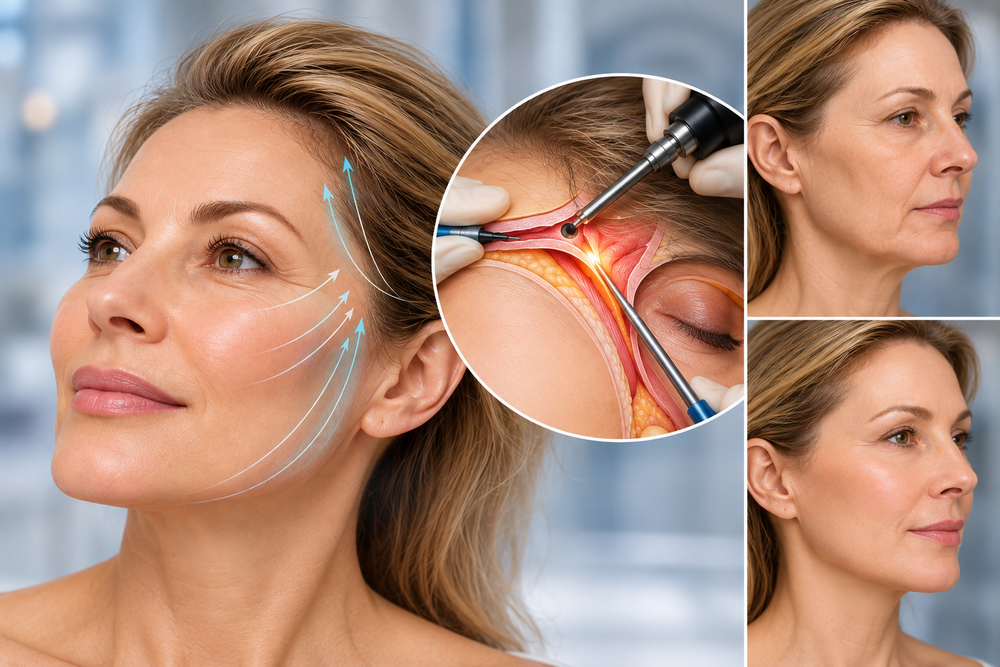
Travelling to Baku for an Endoscopic Facelift: The Ten-Day Recovery Schedule, When You Can Fly Home, and What Happens Afterwards
Most guides to facelift recovery assume you live twenty minutes from your surgeon. If something looks wrong on day three, you drive over. If a stitch needs attention on day six, you call and come in that afternoon.
Travelling for surgery removes that safety net, and it changes the planning in ways that a general recovery timeline does not address. The questions become different ones. How many days do I actually need to be here? When am I allowed on a plane? Who looks after me once I have flown home and my surgeon is three time zones away?
This article answers those questions. For the clinical week-by-week picture of swelling, bruising and healing, the day-by-day recovery timeline covers that ground in detail. What follows is about the travel.
Why Recovery Abroad Needs Different Planning
Three things change when you fly in for surgery.
The early window has to happen locally. The period when complications are most likely and most treatable is the first few days. A haematoma, a collection of blood under the skin, is the most common early complication after facelift surgery and usually develops within the first 24 hours. It is treatable, and it is treated best early. That argues for being within easy reach of the operating surgeon, not in an airport.
Flying is not a neutral act after surgery. Immobility raises the risk of blood clots, which is why walking is encouraged from the first day after a facelift. A long flight is several hours of sitting still, and clearance to board is a clinical judgement rather than a date you pick.
Follow-up has to be designed, not assumed. A local patient gets seen at one week, one month and three months without thinking about it. A travelling patient needs that worked out before booking anything, because the appointments will not all happen in the same country.
The Ten-Day Schedule in Baku
The practice publishes a standard schedule for patients travelling in. It runs to ten days in Baku, and the booking process sets out the stages.
Before you fly. The assessment starts remotely. You send photographs on WhatsApp with a short description of what you want changed, and no appointment is needed to begin. Dr. Mubariz reviews them himself and replies with what he would do, what he would not do, and why. You then receive a written plan and a price before booking anything, with a video call offered if the plan needs discussing.
This order matters. It means you find out whether you are a candidate, and for which operation, before you have bought a flight.
Arrival, then surgery on day two or three. The first day or two covers the in-person examination and preoperative preparation. The face is assessed in repose and in movement, which cannot be done from a photograph, and the plan is confirmed or adjusted.
Dressing change around day five. The dressing is changed and the incisions and swelling are checked.
Cleared to fly between day eight and day ten. This is the step that sets the length of the trip. The published schedule places clearance at day eight to ten, and it is clearance, not a fixed departure date. Whether you are ready on day eight or day ten depends on how you have healed.
Book your return flight so it can move. Patients who buy a rigid non-changeable ticket for day eight are the ones who end up either flying before they should or paying to rebook.
Why You Cannot Fly Home Sooner
The ten days are not padding, and they are not a commercial arrangement. They map onto the period when something might need doing.
Swelling does not peak on the day of surgery. It builds over roughly the first two to four days, which means the point at which you look and feel worst arrives after the operation rather than during it. The dressing check sits inside that window on purpose.
Sutures are a separate reason. In an endoscopic approach the incisions are short and placed in the hairline or scalp, but they are still sutured, and they still need removing. On this schedule you are seen for that before you leave.
Most importantly, the first week is when a problem is most likely to show itself and easiest to correct. Being in the same city as your surgeon during that week is the main thing you are buying with those ten days.
Flying After Facial Surgery
Clearance to fly is a decision your surgeon makes about you, not a rule that applies to everyone. What follows is context, not permission.
The clot risk from sitting still is the reason early walking is encouraged after surgery and the reason a long flight needs clearing. On the flight itself, moving regularly, staying hydrated and following any instructions you were given about compression are the obvious precautions, and your surgeon may add more.
Expect to still be visibly swollen when you board. Clearance to fly means it is medically reasonable to travel, not that you look finished. Most patients describe becoming socially comfortable at around two to three weeks, well after the flight home.
Carry your operative details with you. A short written summary of what was done, what medication you are on and how to reach the surgical team is worth having if you need to see a doctor in your own country.
What Happens After You Fly Home
This is the part travelling patients most often fail to arrange, and the part that matters for months rather than days.
Healing continues long after you land. Most of the obviously visible swelling settles by around the third week. Numbness around the incisions improves gradually over months as the sensory nerves recover. The deeper tissues keep settling, and most patients see something close to their final result between three and six months. Scars continue to mature and fade for up to a year, which is why sun protection on healing scars matters for far longer than the trip.
Agree before you fly out how the remaining follow-up will work. Review appointments are normally spread across the first several months, so some of them will fall after you are home. Photographs and a video call can cover a good deal of that, but the arrangement should be explicit rather than assumed.
Know who you call. You need a route to the surgical team that works from your own country and outside office hours, and you need it before you need it. WhatsApp reaches the practice directly, in English, Russian or Azerbaijani, and there is a separate line for international patients.
It is also worth identifying a local doctor at home who can look at something if needed. Not to take over your care, but so that a question on a Sunday does not become a crisis.
How Much Time to Book
Ten days in Baku is the surgical schedule. It is not the same as the time you should set aside altogether.
Published guidance on returning to work ranges from roughly one to two weeks up to around four weeks, and reputable sources genuinely disagree. The American Society of Plastic Surgeons describes many patients feeling ready at around seven to fourteen days. Postoperative instructions from University of Michigan Health System Plastic Surgery advise approximately four weeks after a face lift. Protocols for less extensive endoscopic procedures often place sedentary work at around a week.
Read that range as a reason for margin rather than an invitation to pick the lowest number. A reasonable approach for a travelling patient is the ten days in Baku plus a buffer at home before anything that matters, and more than a buffer if your work is client-facing or physical.
If you have a fixed commitment, a wedding or a presentation or a return to a visible role, count backwards from it generously. The patients who are disappointed are almost always the ones who planned to the minimum.
Which Procedures Fit a Ten-Day Trip
Not every operation carries the same travel profile, and the difference is worth understanding before you book.
An endoscopic brow lift is the lightest of the group. The work is confined to the forehead and temporal region through small scalp incisions, with no incisions inside the mouth, and it generally has the shortest recovery.
An endoscopic midface lift is different in one specific way that affects travel: the approach uses incisions inside the mouth as well as in the temple, which means a soft diet and careful oral hygiene for the first week to ten days. Plan your eating accordingly, including on the flight.
A full endoscopic or endoscopic deep plane facelift treats more regions, takes longer in theatre and sits at the longer end of the endoscopic recovery range. Where intraoral incisions are used, the same dietary restrictions apply.
If your anatomy requires skin removal, jawline correction or neck work, an open technique will be recommended instead, and you should expect a longer recovery than any endoscopic figure here. That is a question of matching the operation to the anatomy rather than a ranking of techniques, and it is settled at assessment. The full range is described in the facelift surgery guide.
Combining procedures lengthens both the operation and the recovery. If you are considering more than one, raise it during the remote assessment so the trip is planned around the real scope.
Practical Arrangements Worth Making in Advance
A changeable return flight. Clearance comes at day eight to ten, not on a date you choose. Pay for flexibility rather than for a rebooking.
Someone with you, if you can. For the first days after surgery you will not want to manage logistics in an unfamiliar city alone.
Accommodation you can rest in, close to the clinic. You will be travelling back and forth for the dressing change and checks, and head elevation matters for swelling, so somewhere you can prop yourself up and sleep is not a luxury.
Soft food, if intraoral incisions are planned. For midface and some deep plane approaches this is a requirement rather than a preference, and it is easier to arrange before you arrive.
Your medication list reviewed. Blood thinners and certain supplements raise haematoma risk, and you may be asked to stop some well before surgery. Never stop a prescribed medication on your own initiative; any change should be decided by the prescribing doctor in consultation with your surgeon.
Nicotine stopped well in advance. Smoking greatly raises the risk of poor wound healing, haematoma and skin loss after a face lift, according to the Mayo Clinic. This includes vaping and nicotine replacement products.
Blood pressure under control. Poorly controlled high blood pressure raises the risk of haematoma and poor healing, which is exactly the complication you least want while far from home.
Travel and medical insurance checked. Confirm what your policy does and does not cover for elective surgery abroad before you rely on it.
Warning Signs While You Are Still in Baku
Most recoveries are uneventful. Knowing which symptoms need a call rather than a wait is more useful while travelling than at any other time, because you have a flight date in mind and a temptation to minimise.
Contact the surgical team promptly for rapidly increasing swelling or bruising, especially on one side, or bleeding from an incision that is difficult to control with light pressure. Both can indicate a haematoma.
Contact them also for severe or increasing pain not relieved by your medication, increasing redness along an incision, yellowish or greenish discharge or a foul odour, a temperature above 38 degrees Celsius, or any new loss of feeling or movement. These are the warning signs set out in postoperative instructions from University of Michigan Health System Plastic Surgery.
Seek emergency care immediately, rather than waiting for a callback, for difficulty breathing, chest pain or sudden changes in vision. These are general postoperative emergencies rather than facial-surgery-specific ones, and they warrant urgent assessment wherever you are.
Do not fly on a problem. If something is wrong on day eight, the answer is to stay and have it looked at, not to board and deal with it at home.
Warning Signs Once You Are Home
The same list applies, with one addition. After a long flight, new calf pain or swelling, or breathlessness, should be assessed urgently and locally rather than discussed by message, because of the clot risk that prolonged sitting carries.
For anything related to the surgery itself, contact your surgical team as well as any local doctor you see. A photograph sent on WhatsApp often resolves a worry in minutes, and the team knows what your incisions are supposed to look like.
Questions to Settle Before You Book Flights
These are worth having answered in writing during the remote assessment, not discovered on arrival.
Which procedure is recommended for your anatomy, and why that one
What the realistic total time away is, including the buffer at home
Exactly which days you will be seen in Baku, and for what
How follow-up will work after you fly home, and over what period
How to reach the surgical team out of hours, from your country
What the quoted price includes, and what is billed separately
What happens, practically and financially, if you need to stay longer
On the last two, the comparison of endoscopic facelift costs across Azerbaijan, the US and Europe sets out why what a price includes matters as much as the number, particularly when anaesthesia and follow-up are sometimes quoted separately.
Frequently Asked Questions
How long do I need to stay in Baku for an endoscopic facelift?
The practice's published schedule is ten days, with surgery on day two or three, a dressing change around day five, and clearance to fly between day eight and day ten. Treat it as the standard plan rather than a guarantee, since the extent of surgery and your own healing both affect it.
When can I fly home after a facelift?
On this schedule, clearance to fly falls between day eight and day ten. Clearance is a clinical decision your surgeon makes about you, so the date is confirmed during recovery rather than fixed in advance. Book a changeable return flight.
Can I have surgery the day after I arrive?
The published schedule places surgery on day two or three rather than day one. The first day or two is for the in-person examination and preparation, and the face has to be assessed in repose and in movement, which a photograph cannot show.
Do I need someone to travel with me?
It is not a requirement, but it helps considerably in the first days after surgery, when managing logistics in an unfamiliar city is harder than people expect.
How does follow-up work once I am back in my own country?
Review appointments are normally spread across the first several months, so some fall after you have flown home. Agree the arrangement before you travel. Photographs and video calls cover much of it, and WhatsApp reaches the practice directly in English, Russian or Azerbaijani.
Will I look presentable when I fly home?
Probably not entirely. Clearance to fly means travel is medically reasonable, not that healing is finished. Most patients describe becoming socially comfortable at around two to three weeks, which is after the flight. The settled result generally appears between three and six months.
What if I need to stay longer than ten days?
It happens, and it is better than flying early. Ask in advance what that would mean practically and financially, so the possibility is planned for rather than improvised.
Starting the Process
This article is general information and is not individual medical advice. Whether an endoscopic approach suits you, which procedure it would be, and what your recovery and travel would realistically involve all depend on your anatomy, your skin, your health and what you want changed, and none of that can be assessed from an article.
The assessment begins before you commit to anything. Photographs sent on WhatsApp with a note about what you want changed are enough to start, and you receive an opinion and a written plan with a price before booking travel. For an idea of previous outcomes, the surgical results gallery is the place to look, and the contact page carries the phone numbers, including a dedicated line for international patients in English.
Dr. Mubariz Mammadli is a plastic, aesthetic and reconstructive surgeon. Outcomes, recovery and risks vary between patients, and any surgical decision should follow an individual assessment and a full discussion of the alternatives, including the option of doing nothing.