Contents
- Endoscopic Deep Plane Facelift: What It Is, Who It Suits
- Endoscopic Facelift Cost: Comparing Azerbaijan, the US, and Europe
- Endoscopic Brow Lift: Complete Guide
- Why Natural-Looking Facelifts Are Becoming the New Standard in 2026
- Endoscopic Deep Plane Facelift & Advanced Facial Rejuvenation
- Modern Plastic Surgery
- Forehead Lift: Youthful Look with Minimal Scarring
- Waist Slimming Surgery Without Rib Removal In Baku
- Scars After a Deep Plane Facelift, Why They Heal So Well
What is a Tummy tuck surgery?
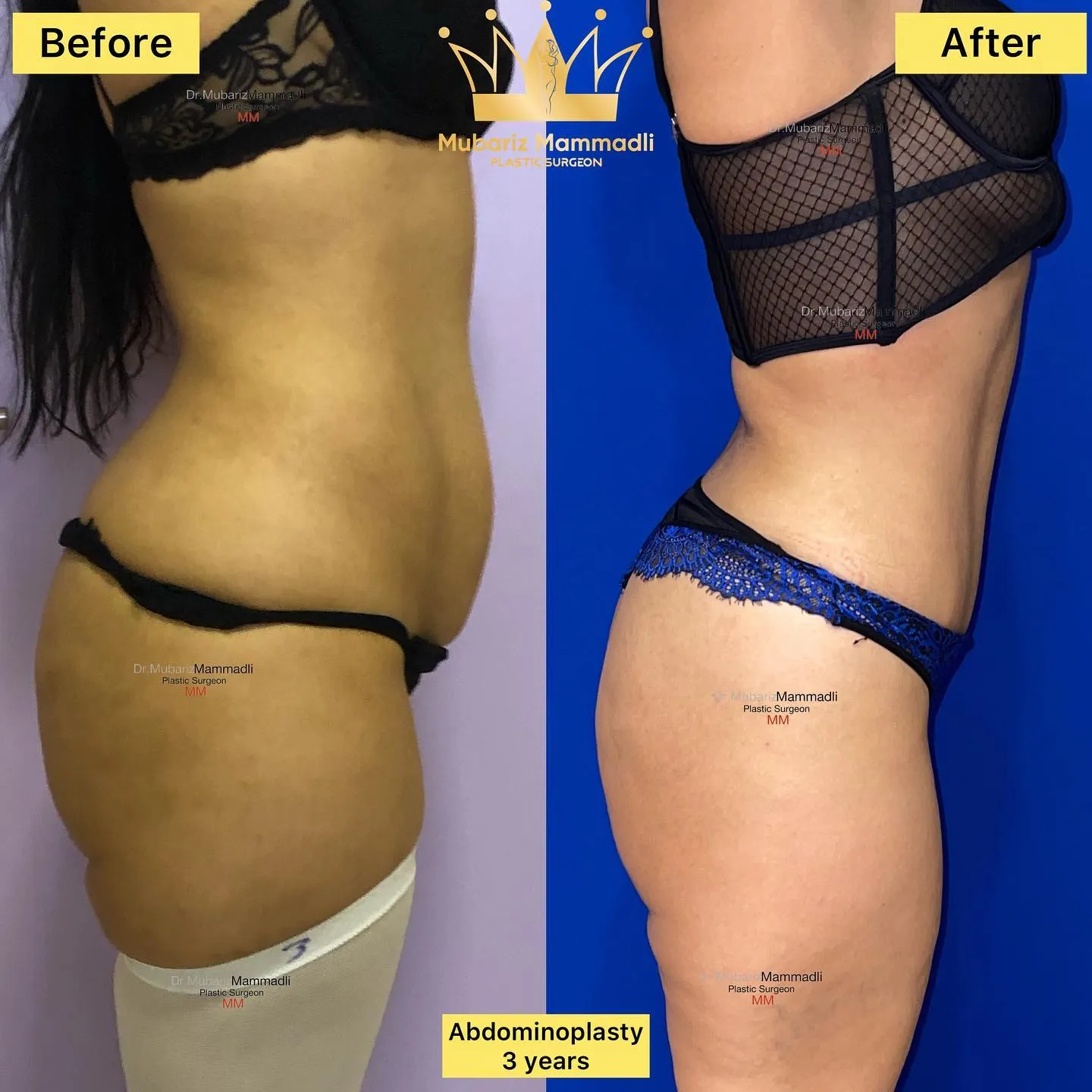
A Tummy tuck surgery, or abdominoplasty, is a plastic procedure. It removes excess loose skin and fatty tissue hanging below, and slightly above, the navel. The operation also smooths creases and reshapes the front abdominal wall.
Causes of abdominal fat
Weight gain, weight loss, childbirth, and your genetic build can all play a part. They lead to loose skin and sagging in the abdominal area.
Fat tissue can collect. Stretch marks can form on the surface of the abdominal skin. The muscles of the front abdominal wall, and the muscle layer, can weaken.
These issues cause real discomfort in trousers, skirts, swimwear, and bikinis. In some cases, severe sagging also leads to skin wounds. Heavy sweating can cause fungal infections in the abdominal folds.
When is a Tummy tuck surgery needed?
Liposuction can correct simple deformities. Even so, a Tummy tuck surgery is usually required.
Depending on the form of the deformity, the surgeon uses different techniques. In some cases, combining the procedure with liposuction gives better results.
For patients with severe sagging and excess skin, the belly button may need to be repositioned and reshaped.
Will there be a scar after a Tummy tuck surgery?
In almost every case, the incision sits above the pubic area. It lies in the same region as a caesarean section.
The incision is planned so the scar hides easily under underwear or a swimsuit. The scar runs a little longer than a caesarean scar. It takes on a normal appearance within six months to one year after surgery.
Who is a Tummy tuck surgery for?
A Tummy tuck surgery can be performed on:
- People without systemic disease,
- People without severe obesity,
- People with creased abdominal skin and a small layer of subcutaneous fat,
- People who have loose abdominal skin,
- People with stretch marks on the abdominal skin.
Tummy tuck surgery: contraindications
A Tummy tuck surgery usually lasts a long time. Every known contraindication is therefore taken into account.
Surgery is especially risky in uncompensated systemic conditions. These include heart, kidney, respiratory, and endocrine diseases.
It is important to remember that this is an aesthetic procedure. It should only be done once every possible risk has been ruled out.
If there is even a small risk, no surgeon and no anaesthesiologist will agree to perform the surgery.
Tummy tuck surgery cost
Several techniques are available for a Tummy tuck surgery. The choice depends on each patient’s build and goals.
For example, the technique chosen for a young woman who has not given birth can differ from that chosen for an older patient. Abdominoplasty cost also varies with the technique.
Recovery
After a Tummy tuck surgery, the patient stays in the inpatient unit of the clinic for two days. During these days, examinations, dressings, and suture hygiene are carried out.
Once the period is over, the patient is discharged home. The key requirements of the recovery period are:
- A compression garment for two months after surgery;
- No physical strain or heating procedures (baths, sauna, solarium, etc.) for two months.
I am plastic surgeon Mubariz Mammadli. Together with my team, I perform abdominoplasty and other aesthetic procedures across Azerbaijan and Baku.